Attraction · Gyeongsangbuk-do
Seongnyugul Cave [National Geopark] (성류굴 (경북 동해안 국가지질공원))
221 Seongnyugul-ro, Geunnam-myeon, Uljin-gun, Gyeongsangbuk-do
The nearest bus stop to Seongnyugul Cave [National Geopark] (성류굴 (경북 동해안 국가지질공원)) is Uljinjonghabundongjang (울진종합운동장) (about 219 m away). See the routes that stop there and live arrival times.
- Opening hours
- March-October 09:00-18:00 / November-February 09:00-17:00 * Last admission is 30 min before closing
- Closed
- Mondays (or the following day if a public holiday falls on a Monday), public holidays, Seollal (Lunar New Year's Day) and Chuseok (Korean Thanksgiving Day) holidays
- Parking
- Available
- Information
- +82-54-789-5404
Nearest bus stops
-
Uljinjonghabundongjang (울진종합운동장)about 219 m · 3 min walk · 3720227Live arrivals
-
Uljinjonghabundongjang (울진종합운동장)about 236 m · 3 min walk · 3720226Live arrivals
-
Seongryugul (성류굴)about 362 m · 5 min walk · 3720229Live arrivals
-
Seongryugul (성류굴)about 397 m · 5 min walk · 3720228Live arrivals
-
Gusan1gyo (구산1교)about 450 m · 6 min walk · 3720224Live arrivals
-
Seongryugul Nammun (성류굴 남문)about 475 m · 6 min walk · 3720812Live arrivals
About this place
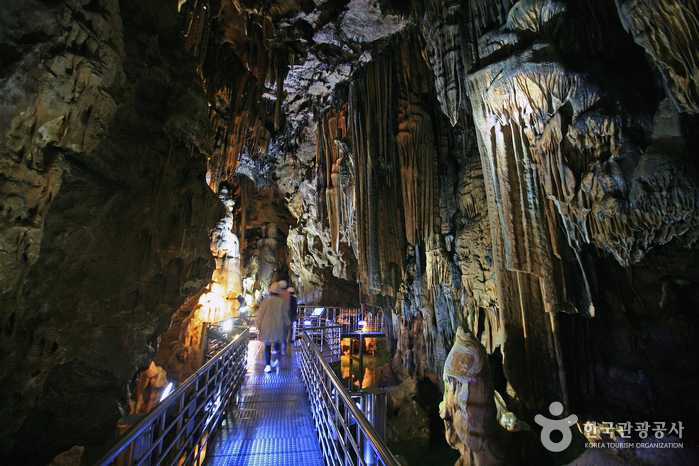
Seongnyugul Cave, a Natural Monument of Korea, is a limestone cave with a general northeast-southwest orientation. It has a total length of about 870 meters, of which only a strip of 270 meters is open to the public. Inside the cave are a variety of cave formations, including stalactites, stalagmites, columns, and cave pearls, which are commonly found in limestone caves. Unlike other limestone caves in Korea, Seongnyugul Cave has twisted columns and submerged stalagmites. Twisted columns are often broken in the middle due to earthquakes that occurred after the columns were formed. Submerged stalagmites are notable because stalagmites usually do not grow under water as they are made from droplets that fall from the ceiling. As such, stalagmites found underwater were submerged after they were created, indicating that they were created during the Ice Age, when the East Sea was lower than the present level.
(Credit: Gyeongbuk Donghaean Geopark)
Photo and description: Korea Tourism Organization (Type 3: attribution, no modification)